What Is White Noise Actually Doing for Baby Sleep?
Part of our Complete Calm Bedtime Guide.
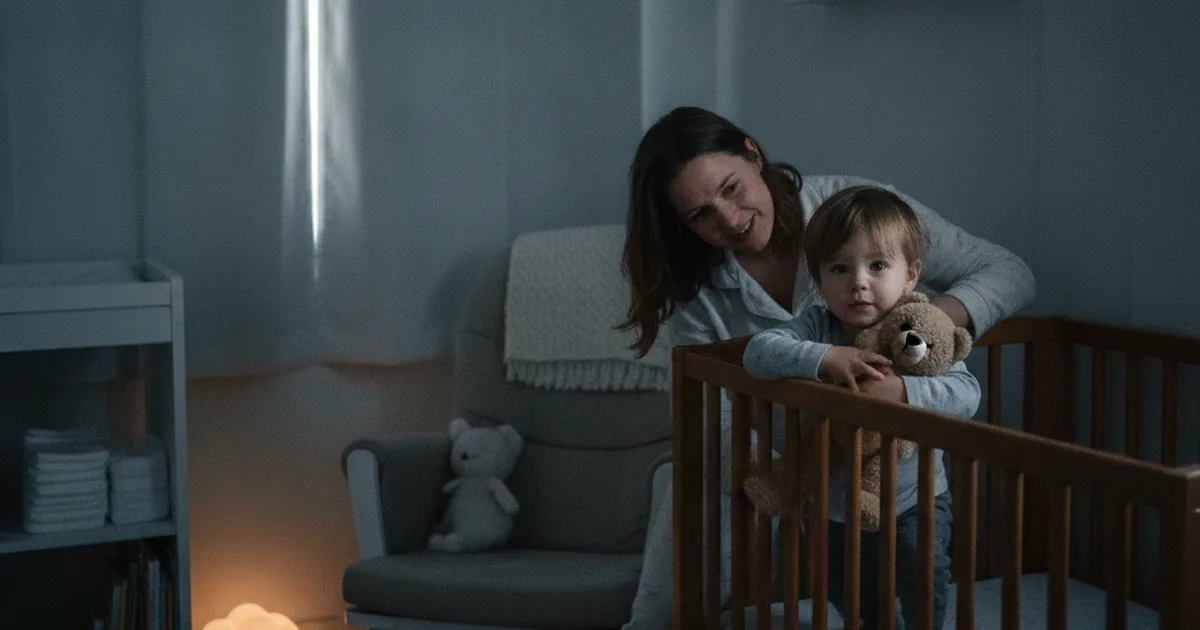
Somewhere between the hospital and the first sleepless week home, most parents end up with a white noise machine, an app, or an old box fan pointed at the crib. It's one of the most universally recommended baby sleep tools — and also one of the least explained. What is it actually doing? Is louder better? Is there a real risk to a baby's hearing, or is that just internet worry? Here's what the research actually says.
What is white noise, exactly?
"White noise" technically means equal energy across all audible frequencies — think static, or the hiss between radio stations. In practice, the term gets used loosely for any steady, continuous sound: a fan, rainfall, a vacuum cleaner, ocean-like rumble, or "pink noise" (deeper and less hissy than true white noise). What actually matters for sleep isn't the exact frequency mix, it's consistency. A sound that stays flat and predictable moment to moment is far more effective than one that varies, which is why waves and birdsong tend to disappoint as sleep sounds despite sounding soothing to adult ears.
Why does white noise actually help babies fall (and stay) asleep?
Two mechanisms do most of the work. First, masking: a steady background sound raises the threshold a sudden noise needs to cross before it registers as "different enough to notice," so a slammed door, a barking dog, or an older sibling thundering down the hall is less likely to fully wake a baby who's cycling through a lighter sleep stage. Second, familiarity: in the womb, a baby hears a constant whoosh of blood flow and muffled sound around 70-90 decibels almost around the clock, so a steady hum after birth can feel less like a novelty and more like a continuation of what they already know. Neither mechanism is mysterious or magical — it's consistency doing the job, which is also why a short, predictable wind-down routine helps for exactly the same underlying reason.
Is there real science behind it, or is this mostly folklore?
There's a real evidence base, though it's more modest than the marketing suggests. Small clinical studies have found that steady background sound helps some infants fall asleep faster and settles crying more reliably than silence, particularly for newborns in the first weeks. What the research does not support is the idea that any one sound has special sleep-inducing properties beyond being steady and masking disruption — a fan does roughly the same job as an expensive machine with a hundred sound options, as long as the sound itself is continuous rather than variable.
How loud is too loud? What the hearing-safety research found
This is the part worth taking seriously. A widely cited 2014 study published in Pediatrics, the American Academy of Pediatrics' own journal, measured the maximum output of 14 popular infant sleep machines at typical crib distances. Every single device exceeded 50 A-weighted decibels at 30 cm — the noise limit recommended for hospital newborn nurseries — and three of them exceeded 85 decibels, a level that, sustained for eight or more hours, surpasses adult occupational noise-exposure limits and raises a real risk of noise-induced hearing damage over time. The concern isn't white noise as a concept; it's specific machines run at maximum volume, placed close to a baby's ear, for an entire night, every night.
How to use a sound machine safely tonight
- Distance: keep the machine at least seven feet (about two meters) from the crib — across the room, not clipped to the rail or tucked inside it. Sound drops off fast with distance, so this alone does most of the safety work.
- Volume: aim for roughly the loudness of a soft shower or a quiet conversation, not louder than needed to mask household noise. A free decibel-meter phone app takes the guesswork out of "how loud is this, really."
- Never point it at the crib or run it right beside baby's head, even at a low volume setting — proximity matters as much as the volume dial.
- Consider a timer rather than running it at a fixed volume the entire night, so it covers the early, lighter sleep stages and steps down or switches off later.
- Choose steady over musical — fan, static, or rain-type sounds mask better than anything with a melody or rhythm.
Could white noise turn into a sleep crutch my child can't do without?
It's a fair worry, and it's possible for a child to build an association between the sound and falling asleep, the same way they might with a favorite blanket or a specific routine. In practice, sleep specialists tend to treat this as one of the lowest-stakes sleep associations there is, precisely because it doesn't require you to be in the room, awake, doing something to your child all night the way rocking or feeding to sleep does. If you'd rather not lean on it long-term, wean gradually — lower the volume a little every few nights over a couple of weeks rather than switching it off cold one night.
When should we stop using white noise?
There's no deadline. Plenty of families use a sound machine well into the school years with no downside, and plenty of others stop after the newborn stage once a baby sleeps through occasional household noise on their own. If you do decide to phase it out, doing it during a calm stretch — not during a big transition like dropping the nap or a house move — makes it far less noticeable to your child.
White noise and a bedtime story solve slightly different problems: one masks the world, the other gives a busy mind something calm to follow instead of racing thoughts. Sleepy Spell was built for that second half of the routine — a warm, screen-dark audio story narrated privately on your device, so no child data is sent - just the story request. Plenty of families run a sound machine in the background and layer a quiet story on top as the mind settles.
Frequently asked questions
How loud should a white noise machine be for a baby?
Most sleep and hearing researchers recommend keeping the sound at or below roughly 50 decibels at the baby's ear — about as loud as a soft shower or a quiet conversation. Many commercial infant sleep machines can produce far more than that at close range, so the safest approach is to measure with a free decibel-meter phone app the first time you set one up, rather than judging loudness by ear.
How far away from the crib should the sound machine be?
Place it at least seven feet (about two meters) from the crib, ideally across the room rather than clipped to the rail or tucked inside it. Sound intensity drops off quickly with distance, so moving a machine from right beside the mattress to the far wall can cut the sound level baby actually experiences dramatically, even at the same volume setting.
Can white noise damage a baby's hearing?
A widely cited 2014 study in the journal Pediatrics tested 14 popular infant sleep machines at maximum volume and found every one exceeded the sound limit recommended for hospital nurseries at 30 cm, and three exceeded workplace noise-exposure limits for adults if run all night at that distance. The risk comes specifically from running a machine too loud and too close for many hours, not from white noise itself — used at a moderate volume and placed well away from the crib, it's considered safe by pediatric hearing researchers.
Will my baby become dependent on white noise to fall asleep?
It's possible for a child to associate the sound with sleep the same way they might associate a particular blanket or routine with it, but sleep specialists generally consider this a low-stakes association compared to ones that require a parent to be physically present all night. If you'd rather not rely on it long-term, you can gradually lower the volume over a couple of weeks rather than stopping abruptly.
What's the best type of white noise sound for babies?
Steady, continuous, low-pitched sounds work best — a fan hum, static, or rain-like sound — because a consistent sound is easier for a baby's brain to tune out. Sounds with a lot of variation, like ocean waves, birdsong, or music with a melody, tend to be more stimulating rather than less, since the brain keeps registering the changes.
Is it safe to run white noise all night, every night?
Yes, as long as the volume stays moderate and the machine is placed well away from the crib; there's no evidence that all-night use itself is harmful at a safe volume. Many parents also use a sleep-timer setting so the machine runs for the riskiest early hours of the night and switches off once a baby is in a deeper sleep stage, though this is a preference rather than a safety requirement.
Sources
Hugh SC, Wolter NE, et al., Pediatrics (American Academy of Pediatrics journal) — Infant Sleep Machines and Hazardous Sound Pressure Levels.
NEJM Journal Watch — Can Sleep Machines Damage Infant Hearing?.
Healthline (medically reviewed) — The Pros and Cons of Using White Noise to Put Babies to Sleep.
American Academy of Pediatrics (HealthyChildren.org) — How to Keep Your Sleeping Baby Safe: AAP Policy Explained.