How to Make Bedtime Work as a Single Parent (No Backup)
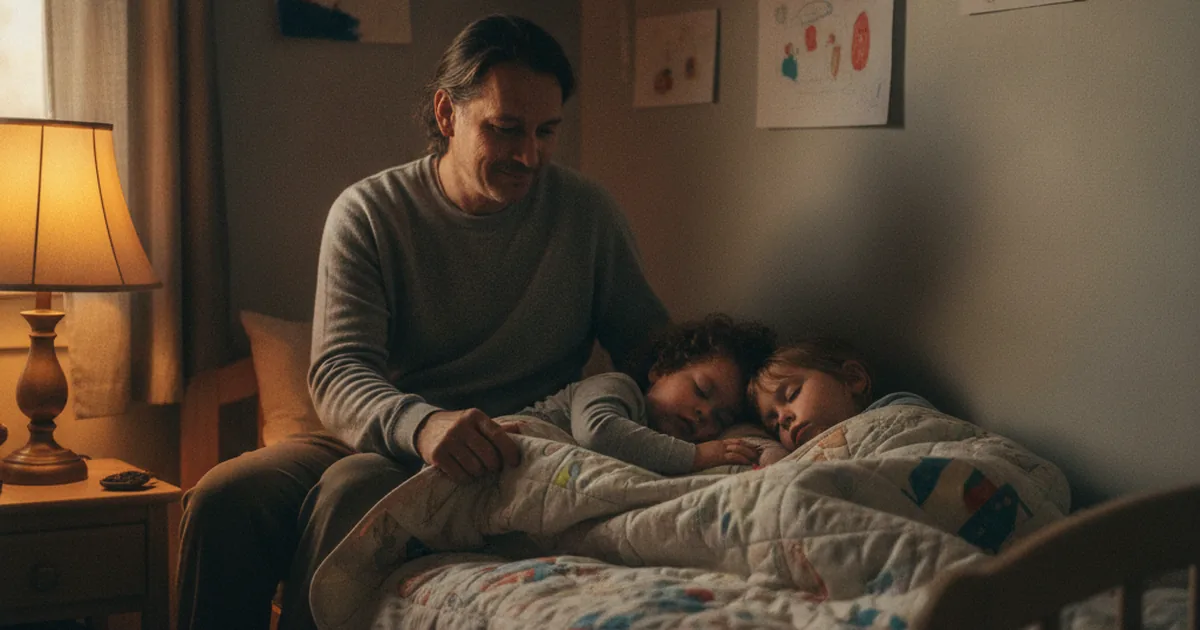
There's a particular kind of tired that comes from doing bedtime completely alone, every night, with no one to hand a crying kid to for five minutes. No partner walking through the door to take over the bath. No grandparent on speed dial for a rough night. Just you, the clock, and however many small people need to be fed, washed, calmed, and put down before you get any time that belongs to you. If that's your house, the goal isn't to do bedtime "better" — it's to make it survivable on the nights you have nothing left, and genuinely good on the nights you do.
Why is solo bedtime so much harder than it looks?
It's not just the physical workload, though that's real — bath, teeth, pajamas, story, water cup, one more hug, repeated per child. It's that you're also the only regulator in the room. Kids co-regulate off an adult's calm; when you're the sole source of that calm and you're running on empty, there's no second adult to step in when your patience runs out mid-routine. Decision fatigue compounds it: by 7 p.m. you've made hundreds of small calls all day with no one to split them with, and bedtime asks for dozens more. None of this means you're doing it wrong. It means the job genuinely takes more out of one person than it's built to, and the fix is to make the job smaller, not to find more willpower.
How do I run bedtime with more than one kid and no second adult?
Two workable models, and which one fits depends on your kids' ages and temperaments:
- Staggered bedtimes — younger child goes down 20–30 minutes before the older one. You get one full, focused routine with the little one, then a shorter, calmer wind-down with the older child who can handle a bit more independence. This works well when the age gap is meaningful (roughly 2+ years) and the older child can occupy themselves quietly for a short window.
- Shared start, staggered finish — bath and pajamas happen together to cut the workload in half, then you split off for individual stories or wind-down time, even if one child's "story" is just three minutes long some nights. This tends to work better for close-in-age siblings, and it's the same logic we cover in more depth in bedtime routines for two kids sharing a room — a lot of the shared-room strategies (same room, different needs) map directly onto shared-parent, no-backup nights too.
Whichever model you use, resist the urge to run two completely separate, full-length routines back to back — that's the version that reliably eats your whole evening and leaves nothing for you.
What's the simplest routine that still actually works?
Elaborate routines are a luxury of having backup. Without it, the routine needs to be short enough to do consistently even on your worst night, because a routine you skip half the time teaches kids nothing predictable. Aim for four steps, in the same order, every night: wind down (dim lights, quiet activity), hygiene (bath or wash-up, teeth), one calming input (story or quiet chat), lights out with a fixed goodnight phrase. That's it. A full breakdown of trimming a routine to its essentials is in building a short, predictable wind-down — the core idea is the same for a two-parent house and a one-parent house: consistency of order matters more than length.
For the "calming input" step, a lot of solo parents find that handing off the story-telling part — without handing off the closeness — is what actually buys back energy on the hardest nights. That's part of why we built Sleepy Spell as a screen-dark, offline audio story app: you can still be right there, lights low, kid curled up next to you, but the narrating isn't entirely on you when your voice is the one thing you don't have left at 7:45 p.m.
What do I do on a night I have genuinely nothing left?
Have a real "minimum viable bedtime" decided in advance, not improvised in the moment when you're already depleted — teeth, pajamas, one short story or five minutes of quiet audio, lights out. Skipping the bath one night, or shortening the story to two pages, is not a failure of the routine; it's the routine working as designed, because a routine that only survives on your best nights isn't actually reliable. Kids adapt to a shorter-but-still-predictable sequence far better than to a routine that swings wildly between elaborate and abandoned depending on how your day went.
How do I get a break at bedtime with no one to tag in?
You can't outsource the routine most nights, but you can build in small, real breaks inside it. A few that solo parents report actually help: let an older child "read" quietly to a younger sibling for a few minutes while you catch your breath in the hallway; use a consistent audio story for part of the wind-down so you're present but not required to perform; ask a neighbor, friend, or relative for one bath-and-pajamas night a week if that's available to you, even remotely (a video call "goodnight" from a grandparent can cover ten minutes of your routine). None of these need to happen every night to matter — even one small offload a week reduces the sense that bedtime is a wall you hit alone every single day.
How do I protect my own evening when bedtime is the last thing I do all day?
Pick one fixed moment that marks "bedtime is over" — the door closing, a specific song ending, the last hallway light going off — and treat it as non-negotiable, the same way you'd treat a work meeting ending. Without a second adult to hand things off to, it's easy for bedtime to blur into an open-ended evening of re-entering the room for one more request. A clear, consistently-enforced end point (with a brief, boring response to the third "I need water" — calm, short, back to bed) protects the twenty or thirty minutes that are actually yours. This isn't about being stricter with your kids; it's about being fair to yourself, because a parent with zero recovery time each evening runs out faster than one with even a small, protected buffer.
Frequently asked questions
What's a realistic bedtime routine length for a solo parent with two kids?
Aim for 20–30 minutes total when you're running it alone, not 20–30 minutes per child. A shared bath-and-pajamas step followed by a short, individual calming step per kid usually fits that window and is far more sustainable night after night than two full separate routines.
Is it bad for my kids if bedtime looks different some nights (shorter, no bath, etc.)?
No — what matters most is the order of steps staying the same, not the length. A shortened but predictable sequence (teeth, one short story, lights out with the same goodnight phrase) still gives kids the cue that sleep is coming, even on nights the full routine doesn't happen.
How do I handle a toddler who stalls bedtime with "one more thing" when I'm the only adult around?
Decide the response in advance rather than in the moment: acknowledge briefly, don't negotiate, and return to the same fixed end point every time (a set phrase, then leaving the room). A calm, boring, consistent response to stalling tends to reduce it faster than either giving in or getting frustrated, and it protects the small amount of evening time you have left.
Should I feel guilty about using audio stories instead of always reading myself?
No. What matters most for a calm wind-down is a dim room, a predictable routine, and your presence — not who's doing the narrating. A quiet audio story with you sitting close by still delivers the closeness and calm; it just doesn't require your voice to be the thing carrying the night on an already-depleted evening.
My kids are close in age — should I still try to stagger their bedtimes?
Not necessarily. For siblings close in age, a shared start (bath, pajamas, brushing teeth together) followed by a brief individual step per child often works better than staggering, since staggering works best with a bigger age gap where the older child can occupy themselves independently for a while.
How do I get any kind of break if I truly have no backup at all?
Look for small offloads rather than a full break: a short video call goodnight from a relative, an older sibling "reading" quietly to a younger one for a few minutes, or a consistent audio story segment that lets you be present without performing. These won't replace a second adult, but even one small weekly offload measurably reduces the sense of carrying bedtime entirely alone.
Sources
Sleep Foundation — Perfecting Your Child’s Bedtime Routine.
ZERO TO THREE — The Power of Routines.
American Academy of Pediatrics (HealthyChildren.org) — Healthy Sleep Habits: How Many Hours Does Your Child Need?.
CDC — Essentials for Parenting Toddlers and Preschoolers.